
Somewhere around 2017 I stood in front of a wall in a client’s office in southern Germany. On the wall was a ladder. Six tiers, each with a name and a number: ninety percent of stories done per sprint, ninety percent of builds green, cycle time cut in half, and so on up to a tier we had called agile innovation. Every team in the building had a marker on that ladder. The marker was the point of the engagement. Teams climbed, the markers moved, and once a quarter somebody from the steering committee came to look at the wall and went away reassured.
I had helped design that ladder. At the time I was proud of it, and not without reason: it was honest about what it measured, it gave coaches and managers one picture to talk about, and the teams on the upper tiers were genuinely better at their work than the teams on the lower ones. The framework behind it was called Agile Evolution. We described it as a management tool for continuous improvement in everyday life, a process plus a catalogue of metrics and practices for managers and coaches. It had three phases, Readiness, Transition and Evolution, and a maturity model for teams, roles and the organization as a whole.
What I did not see in front of that wall, and what took me the better part of eight years to see, was that the ladder had an end. The top tier was a place you arrived at. And an organization that has arrived has, by that very fact, stopped doing the one thing that got it there.
This post is about the route from that wall to The Tautai Principle, the book I published in 2025, and to the belief core my company works from today. I want to tell it as a route rather than as a before and after, because that is what it was: a series of waypoints, each of which I believed in when I reached it, and most of which I have since sailed past. The middle stretch has a name, GRADO, and it is the stretch where the word transformation went overboard.
Agile Evolution, 2015 to 2019
Let me be fair to the framework first, because I still use half of it.
Agile Evolution was built for a real problem. Companies in the mid-2010s had Scrum teams that worked and organizations around them that did not. Every coach in the business had the same conversation: the team is fine, the trouble starts at the first management layer above it. We wanted a method that let a manager run the improvement of a whole organization the way a good team runs its own, with a cadence, with evidence, with a backlog.
So we built one. Readiness: six to eight weeks of interviews, self-assessments, a business objective, a first scope and a transition team. Transition: pilots, stepwise expansion, management moving from achiever to catalyst. Evolution: change as a construction element of the organization, retrospectives and empirical planning as the backbone, no external support needed. From 2018 the heart of it was a double loop we called the Corporate Double Loop Learning Cycle, two cycles joined at Act and Learn, one for making sense of the situation and one for leadership. The first loop still exists today under the acronym GOOD. The second still exists as FAEE. If you have sat in a Tautai Foundations course, you have drawn both.
The framework was good at what it set out to do. It was also, I now think, built on three load-bearing assumptions that I never questioned because nobody around me did.
The first was that change has a shape: it starts, it passes through phases, it ends in a state called Evolution where the organization runs by itself. The second was that progress can be measured on a ladder, and that the ladder is the same for every team. The third was that none of it starts without a sponsor, because sustainable change, as we wrote in so many words, can only be driven by management.
Hold on to those three. They are the waypoints.
GRADO, 2018 to 2024: the long middle
Agile Evolution grew into a book project. The working title was Growing Adaptive Organizations, GRADO for short, and over six years it grew into eight parts along a lifecycle, Strategy, Design, Run, Grow, Lead, plus a volume of tools. The manuscript ended at roughly 290,000 words. The chapter skeleton of the main part, the one that was supposed to hold the argument together, stayed empty. I mention this not as a confession but as a diagnosis: I could write everything around the centre and could not write the centre, and it took me a while to understand that this was information.
GRADO was where my thinking moved most, and it moved in two directions at once.
On one side it moved away from the ladder. GRADO’s opening sentence was that this is a book about complexity. The condition organizations face is not that they are too slow but that the environment changes faster than it can be known. From that we got the Viable System Model as the nervous system of the organization, Cynefin for telling the kind of situation you are in, Endsley’s situational awareness, the idea that every intervention in a complex system is an experiment because there is no reliable link between what you do and what happens. We wrote, in German, wir erstellen den Weg, indem wir ihn gehen: we make the path by walking it. We wrote that unfreeze, change, refreeze was no longer sufficient. We even wrote, about our own three phases, that these are not really phases, they overlap and are fractal.
On the other side GRADO kept everything the ladder stood on. It kept the maturity model, now with borrowed ladders from four other frameworks beside our own. It kept Readiness, Transition and Evolution as the engagement design. It kept the sponsor. It added a strategy canon from the positioning school, Porter and Rumelt and Play to Win, with a develop-then-implement chain and gap-to-target planning: here is where we are, here is where we want to be, here is the backlog that closes the gap. It argued that hierarchy and network are both necessary and the job is to find the balance. It called stable teams the golden nugget.
So far so good. But I was holding two books in one manuscript. One said the terrain changes when you walk on it. The other handed you a map with a destination marked. And somewhere in the Grow part, in a section on the forms that change can take, I had written the sentence that gave the game away without my noticing. We distinguished four movement forms: Change, Transformation, Evolution and Hack. Transformation was defined as one-time planning and execution, and it was kept as legitimate because, as the note says, it lowers transaction cost, for example anxiety.
Read that again. I had kept transformation in the framework because it made people less anxious.
The day transformation went overboard
I cannot give you a date. It was not a day; it was a client.
A mid-sized company, two years into a transformation program I had helped frame. The sponsor who had commissioned it had been promoted sideways. The new one asked me, in our first meeting, a perfectly reasonable question: when will it be done? I gave the answer the framework gave me. Evolution is the phase where the organization runs by itself, we are not there yet, here is the maturity picture. He looked at the picture and said: so we are at level three of six, and the plan was to be at five by now.
He was right. We were behind plan. And standing there I understood that the entire conversation was being held in a language that had nothing to do with whether his company could survive the next five years. The ladder measured how agile the teams were. It did not measure whether the company noticed what its customers were doing, whether its decisions sat anywhere near the information they needed, whether it could change its shape without losing its sense of what it was. We had spent two years making the teams better at a thing while the thing the company was for drifted. The transformation had a beginning, a middle and a plan for its end, and the environment it was supposed to answer to had none of the three.
The word I reached for in the following months was viability, and I found it had been sitting in GRADO’s own term field all along. Robust systems stay unchanged until they break. Resilient systems take damage and recover, changed. Adaptive systems actively change to remain viable. Viable systems actively maintain their identity over time. Those four words had been in my manuscript as a taxonomy. I had never let them be the argument.
Once they were, transformation had no place to stand. A transformation is a change with an end state. A viable organization has no end state; it has an identity it keeps and a structure it keeps changing. The belief core my company publishes today puts it in one sentence: an organization’s only stability comes from constant adaptation. Stability is not the absence of change but its product. If you believe that, you cannot also believe in a program that finishes.
I consider this the one real break in the route. Everything else is a waypoint. This one is a change of vessel.
The waypoints
When I laid GRADO and Tautai side by side last year, one concept at a time, the differences fell into a list of nine. Most of them are the same difference seen from different angles. Here are the ones that matter, each told as the position I held and the position I hold.
Phases. I held: Readiness, Transition, Evolution, six to eight weeks for the first, then pilots, then the organization runs by itself. I hold: there are no phases, because there is no project. There is a 90-day cycle of probing, sensing and deciding, and the cycle is the operating rhythm, not the scaffolding you remove afterwards. GRADO had already written that the phases are fractal and overlap. It had not drawn the conclusion.
Maturity. I held: a ladder, the same for every team, with numbers on each tier. I hold: a diagnosis made at the level that faces its own environment. One grade for the whole company hides exactly what a leadership team needs to see, and a team’s grade on a generic ladder hides what that team’s customers are doing to it. GRADO’s own manuscript carries the doubt in the margin: maturity, or competence level? I should have listened to my margin.
The sponsor. I held: nothing sustainable starts without management driving it. I hold: the capacity we are building is the organization’s own, held collectively and distributed to the units that face their own environment, so a sponsor is the person who grants access and can absorb a finding that embarrasses them, and nothing more. The work belongs to the units. A unit that cannot decide where its own information sits has no adaptive capacity, whatever the org chart says it has. GRADO had the better instrument here, a whole module on power, scope and influence that the Tautai book does not have, and I have just carried it back across. The instrument was right. The conclusion it served was not.
Strategy. I held: positioning, then a develop-then-implement chain, then a gap-to-target plan. I hold: direction over destination. You cannot plan toward a state in a terrain that changes when you walk on it. What you can do is hold a direction, run probes with stop conditions, and commit at the last responsible moment. That timing rule is GRADO’s too, by the way. It was always the sanest thing in the strategy part.
Hierarchy and network. I held, with Kotter: both are necessary, find the balance. I hold: a dual operating system, in which the two run separately and the network is supposed to be the agile bit, is simply toxic, and I have said so in print. A structured network with visible authority is one organization, not two.
Stable teams. I held: the golden nugget. I hold: dynamic teams that form around needs. And here I will be honest about the survey: GRADO has a cost argument for stable teams, Tuckman and transaction costs, that the dynamic-teams position has not fully answered. This waypoint is still being charted.
The premise. This is the one I passed twice. GRADO began from complexity. When I wrote the Tautai book I began from the race: you lose to faster competitors, not smarter ones, and the Speed Gap between how fast your environment changes and how fast you respond is the book’s central lens. Then, a year after the book, I wrote the belief core and found I had to demote the race. Speed is a consequence of how well you sense and how close your decisions sit to their information. It holds where a race is the frame. Much of the work worth doing is not in a race. That is GRADO’s position, and I had sailed a full circle to get back to it. I keep the Speed Gap as a diagnosis. I no longer let anyone set it as a target.
What I carried along
A route is not a repudiation. If I count what crossed from Agile Evolution through GRADO into Tautai unchanged, the list is longer than the list of waypoints: GOOD and FAEE joined at Act and Learn, the Viable System Model as the nervous system, Cynefin, situational awareness, interventions as safe-to-fail experiments, alignment over compliance, decisions at the lowest sensible level, adaptive space, identity as the starting point, and the whole question of what makes an organization viable rather than merely efficient. GRADO is not a wrong book. It is a toolbox with a blurry centre, and the Tautai book is a centre with a thin toolbox, and I am spending this autumn carrying tools across from one to the other, each one rewritten so that it serves viability rather than transformation.
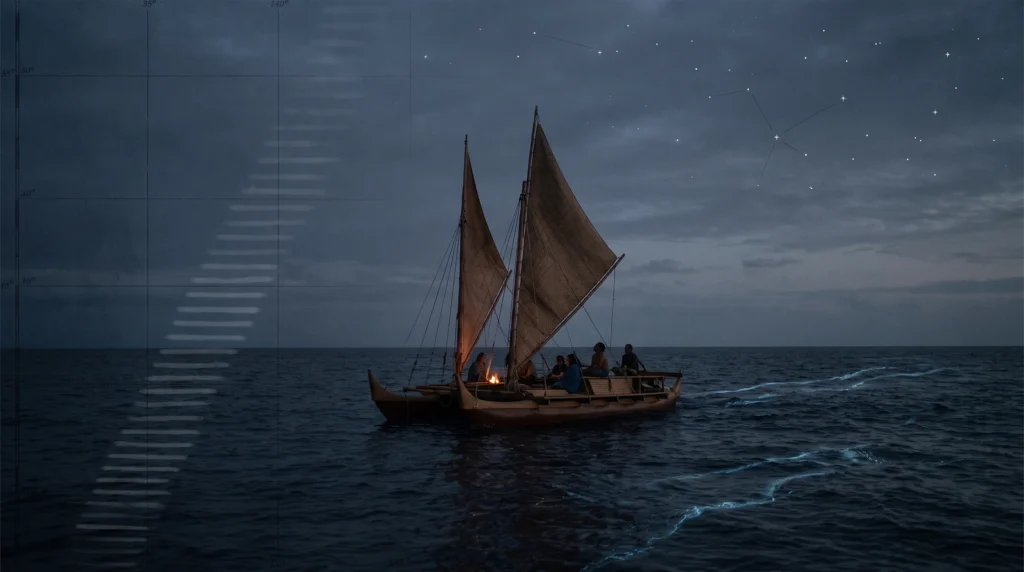
The name helps me here. A tautai is a Polynesian navigator, one of the people who crossed open ocean without instruments by reading swell, birds and stars, holding a direction rather than a destination and correcting constantly. The thing a tautai never did was announce that the voyage was complete and the canoe could now stop reading the water.
That is where the route has brought me. Not to a place, and I would distrust myself if it had.