
Artificial intelligence is usually discussed in terms of what machines can do. Can they write, reason, diagnose, design, or make decisions? Will they help us, replace us, or eventually escape our control?
These are important questions, but they begin with the technology. The five-dimensional framework starts somewhere else: with people.
Its central question is:
How does a technology, institution, or social condition affect our ability to shape what happens next?
This ability is called human agency. In simple terms, agency means being able to influence your life and your environment through purposeful action. It is the difference between merely experiencing events and participating in their direction.
Agency is not the same as freedom, skill, motivation, or power. It depends on all of them, but none is sufficient by itself. A highly skilled person may be unable to act because an organization gives them no authority. Someone may have complete freedom but lack the knowledge required to use it. Another person may possess both ability and opportunity but feel no commitment to act. And even determined action can become empty activity when it lacks a meaningful direction.
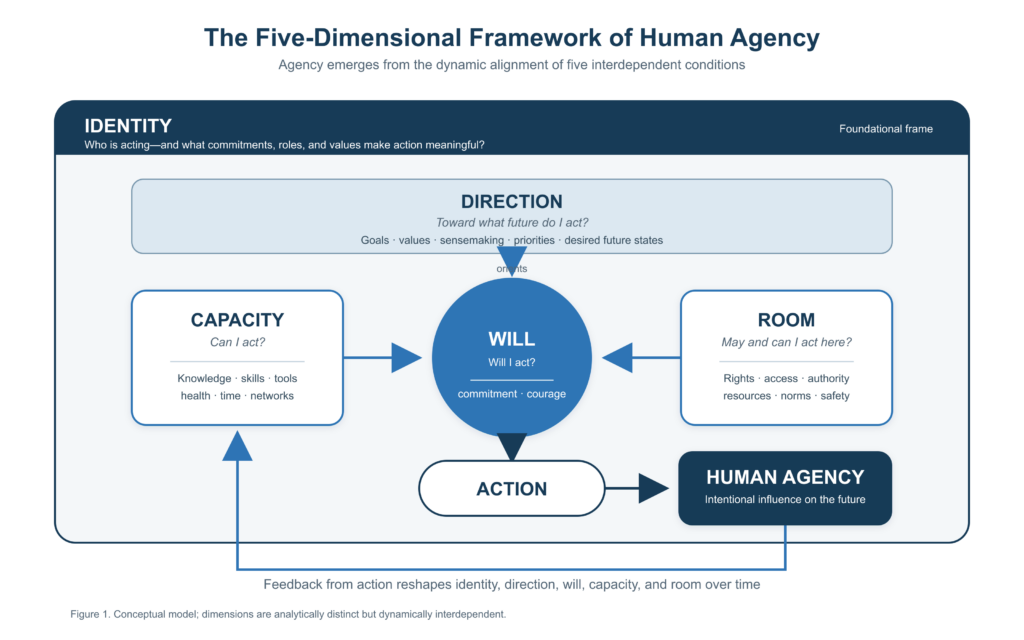
The framework therefore distinguishes five interdependent dimensions.
Capacity: Can I act?
Capacity includes the knowledge, skills, health, tools, time, resources, and relationships needed to do something.
A person who cannot program may acquire that capacity through an AI assistant. A patient may gain the capacity to understand a diagnosis through accessible information. A small organization may suddenly be able to analyze data that previously required an expensive specialist.
AI can increase Capacity dramatically. But producing an answer is not always the same as developing understanding. If people become dependent on systems they cannot question or operate without, short-term augmentation may eventually produce deskilling. The relevant question is therefore not only whether AI improves performance, but whether it strengthens a person’s lasting ability to understand and act.
Room: May and can I act here?
Having the ability to act does not mean having the opportunity or permission to use it. Room describes the legal, economic, organizational, social, and psychological space available for action.
It includes formal rights, access to resources, decision-making authority, available time, cultural expectations, job security, and the safety to disagree or make mistakes.
An employee may know how to solve a problem but be prevented by rigid procedures. A worker may technically be allowed to question an automated decision while fearing retaliation for doing so. A citizen may possess a legal right but lack the money or institutional access needed to exercise it.
Room is where agency becomes a question of power. Institutions determine who may decide, who must comply, whose judgment counts, and who can challenge the rules.
Will: Will I act?
Capacity and Room describe what a person could do. Will (in sense of Schopenhauer) concerns whether that possibility is actually translated into action.
Will includes motivation, commitment, courage, persistence, self-efficacy, and the willingness to accept responsibility. It is stronger than a passing intention. We often intend to do things without committing ourselves to them.
Will can be strengthened when people experience competence, ownership, and meaningful progress. It can be weakened by chronic insecurity, repeated powerlessness, surveillance, or systems that make personal initiative unnecessary.
Convenient technology can therefore have an ambiguous effect. It may give people the confidence to begin something they previously considered impossible. But it may also encourage passivity if decisions, judgments, and difficult choices are continuously delegated to machines.
Direction: Toward what do I act?
Agency requires more than the ability and determination to act. It also requires some conception of what is worth doing.
Direction includes goals, values, priorities, purpose, sensemaking, and images of a desired future. It helps us choose between multiple possible actions and evaluate whether our efforts are moving toward something that matters.
AI can expand the range of options available to us, but it can also influence which options become visible. Recommendation systems direct attention. Performance metrics replace complex purposes with measurable targets. Automated suggestions can gradually turn assistance into agenda-setting.
The problem is not simply that systems tell us what to do. It is that we may stop noticing when their objectives have become our own.
Identity: Who is acting?
Identity is the framework within which a person understands who they are, what they value, and what responsibilities they accept.
“I am a teacher,” “I am a scientist,” “I am a parent,” and “I am a citizen” are not merely descriptions. They shape which possibilities appear meaningful, which commitments seem binding, and which futures are worth pursuing.
Identity helps generate Direction. Direction focuses Will. Will mobilizes Capacity. Room determines whether these capacities can become effective action.
But the relationship is not one-way. Action also reshapes Identity. When people successfully influence their circumstances, they may begin to understand themselves as capable authors of change. When they are repeatedly ignored, overruled, or made dependent on systems they cannot understand, their sense of themselves as agents may erode.
Agency is a system, not a checklist
The five dimensions should not be treated as separate boxes that can simply be added together. They form a dynamic system.
A person may have strong Capacity but little Room. Another may have Room but insufficient Will. A third may act forcefully while pursuing a Direction imposed by someone else. Weakness in one dimension can restrict the entire configuration.
At the same time, the dimensions influence one another. Greater Capacity can strengthen confidence. Expanded Room can encourage initiative. Successful action can reinforce Identity. Repeated failure or exclusion can produce the opposite effects.
Agency is therefore not something a person either possesses or lacks. It varies across situations, relationships, institutions, and periods of life.
Why this matters for artificial intelligence
The common story imagines a competition:
Human agency versus AI agency.
The more capable AI becomes, the less agency remains for humans.
Sometimes that is a useful warning. But it is not the whole story. AI does not enter an empty world. It is developed, owned, purchased, regulated, and deployed by people and institutions. Its consequences depend on who controls it, who can access it, who benefits from it, and who must live with its decisions.
The more revealing question is therefore:
Who gains agency through AI, who loses it, and where does agency become concentrated?
An AI system may increase the Capacity of workers while reducing their Room through surveillance. It may make students more productive while weakening their Will to struggle with difficult problems. It may help people explore new Directions while allowing platforms to steer their attention. It may support professional work while destabilizing professional Identity.
These effects are not determined by the technology alone. They are shaped by leadership, ownership, regulation, workplace design, education, social norms, and economic inequality.
This turns the future of AI into a social and political question. We are not merely deciding which machines to build. We are deciding what kinds of human beings, organizations, and societies those machines will help create.
A practical question for every AI decision
The framework can be applied to a workplace tool, an educational platform, a public policy, a social-media system, or a personal decision. In each case, ask:
- Whose Capacity increases or decreases?
- Whose Room to act expands or contracts?
- Does the system strengthen initiative and responsibility, or encourage passivity?
- Who determines the Direction?
- How does the change affect people’s Identity and sense of authorship?
- How are these effects distributed?
- What do we know, what are we merely assuming, and what must we learn through careful experimentation?
This does not produce automatic answers. That is precisely the point. Agency is not a single score that eliminates political disagreement. The framework makes the disagreement more visible: it reveals which human possibilities are being created, constrained, transferred, or quietly abandoned.
The purpose of AI governance should therefore be broader than controlling machines. It should include shaping the conditions under which people can continue to understand their world, choose meaningful directions, accept responsibility, and act together.
The central challenge of the AI age may not be whether machines become agents. It may be whether human agency becomes more widely distributed—or increasingly concentrated in the hands of those who design, own, and govern the machines.
Find a more theoretical description in this draft paper: