
Why a cybernetician born 100 years ago is suddenly relevant to your inbox.
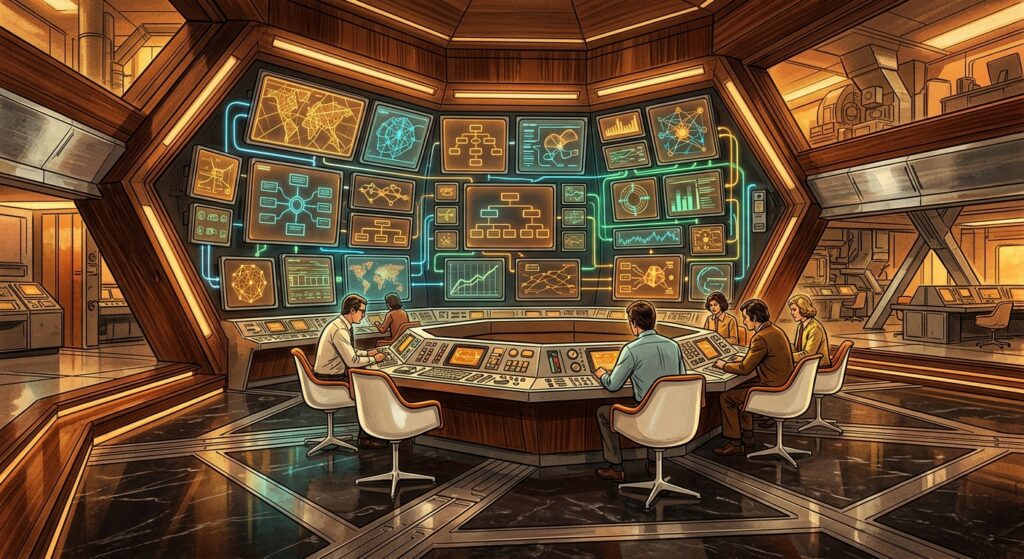
In 1971, Stafford Beer wired the factories of Chile to a single room. Telex machines carried daily production data to a central hub, and a handful of people sat in a hexagonal operations room — futuristic swivel chairs, screens on the walls — trying to see the state of a national economy and steer it almost as it happened. The project was called Cybersyn. It remains the most ambitious attempt ever made to regulate a complex system in close to real time.
Beer was born in 1926. In September 2026, the global cybernetics community gathers in Manchester to mark his centenary at Metaphorum 2026 — “100 Years of Stafford Beer.” The anniversary is a good moment for a blunt question: why should anyone running an organization today care about a man who died in 2002?
The answer is that Beer was never really interested in computers or control rooms. He was interested in viability — the capacity of any organization, from a five-person team to a nation, to keep its identity and keep working in an environment that will not stop changing. His Viable System Model is a map of the functions every organization needs to stay adaptive: doing the work, coordinating it, running the present well, sensing what’s coming, and holding a clear sense of what the whole thing is for. Get those functions and the connections between them right, and the organization can absorb shocks. Get them wrong, and it falls behind — slowly, then all at once.
That diagnosis has aged unusually well. The pressures Beer wrote about — rising complexity, faster change, the difficulty of governing anything large — are exactly the pressures leaders name today, now amplified by AI, ecological limits, and a general sense that the old playbook reacts too slowly. His questions are not historical curiosities. They are this quarter’s problems in older clothing.
This essay opens a short series. Over the next nine pieces I’ll walk through Part 1 of a book in progress, The Organizational Future, which reads the most familiar modern management complaints — we’re too slow, we can’t predict anything, our best people are drowning in noise — through Beer’s lens, and asks a deliberately sceptical question each time: does cybernetics actually add something here, or is it just a better vocabulary for what good managers already know?
The answers aren’t all flattering, which is the point. Some chapters find that cybernetics genuinely extends what we can do. Others find it mostly re-describes good practice in sharper language. By the end, you’ll have a working map of where the cybernetic toolkit earns its place — and where it doesn’t.
A few things to expect. Each essay is short and stands on its own, so you can start anywhere. None of them assume you’ve read Beer. And each one ends where this one does: pointing toward Manchester, where these questions get argued out in person.
If the series does its job, the centenary won’t feel like a tribute to a dead theorist. It’ll feel like the moment a set of fifty-year-old ideas got handed back to the people who actually run things — to test, to break, and to use.
Next week: the one problem underneath all the others — why “we’re too slow” is the disadvantage that decides everything else.
This opens the countdown to Metaphorum 2026 — “100 Years of Stafford Beer” (17–19 September 2026, Alliance Manchester Business School, Manchester), where I’m convening a half-day “Cybernetic Futures” workshop [workshop slot — TBC]. Programme, themes, and registration: conference2026.metaphorum.org. You also contribute as a speaker: Abstract deadline: 17 July 2026.