
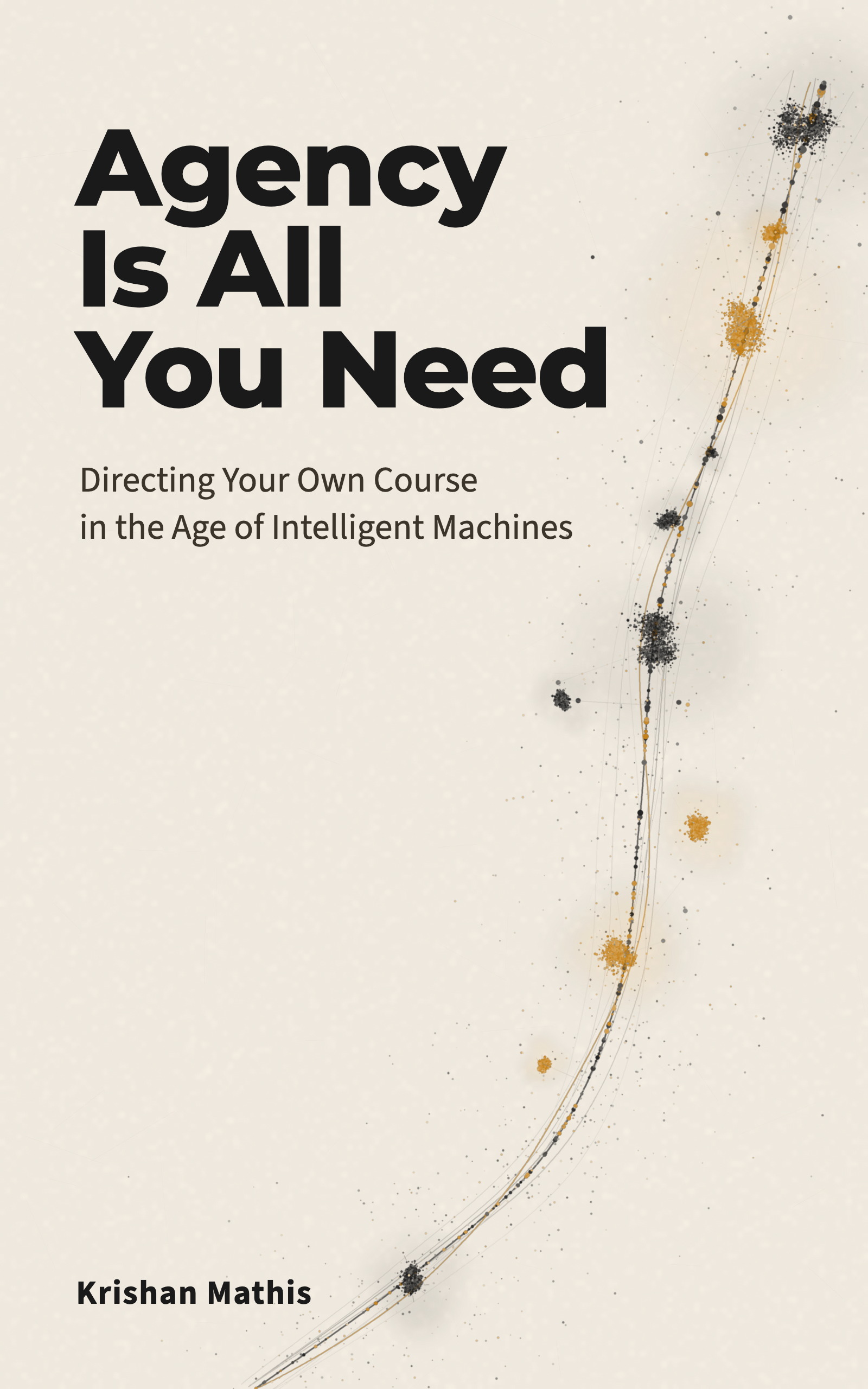
Agency Is All You Need
Directing your own course in the age of intelligent machines.
Agency is the capacity to direct your own course. It is built rather than inborn, it has three operational dimensions — capacity, room to act, will — and you are limited by the weakest of them. The structures that used to supply direction are being dismantled faster than anything replaces them.
Flyer: A5, two sides, draft v0.5, 9 November 2026. The book is published in paperback and e-book.
Who it is for
A good fit
- Individuals whose working life has stopped following the script: a department named, a ladder carried out of the building one rung at a time
- People who are being told to be more agentic and want to know what that actually consists of
- Small groups and teams that want to read their own conditions without waiting for a mandate
- Readers of The Tautai Principle who want the individual layer of the same argument
Not a fit
- Managers looking for a program to install in other people
- Anyone wanting a morning routine, a mindset hack, or the promise that agency replaces rights, money, health or luck
- Institutions: this is a book for individuals and small groups
- Readers who want an alarmist book about artificial intelligence. It offers hope instead
The problem it addresses
For two generations, most people in wealthy countries did not need much agency at work. School, university, employer and profession supplied the direction. That scaffolding is now being dismantled — by artificial intelligence and by ordinary market disruption — faster than anything replaces it. Each of us has to steer more of our own course than we were ever prepared to.
The memo arrives on a Friday at 16:12. By Sunday evening Sonja has read it four times. Her department is named. Not her job, her department. The ladder she has been climbing for eleven years is being carried out of the building, one rung at a time, while everyone continues to stand on it.
Two people carry the argument: Sonja, who has room but a will grown dependent on being chosen, and Abdellatif, an electrician who loads trucks while a chamber sits on his credential file — will and skill in abundance, and almost no room.
Three dimensions, one rule
Agency has three operational dimensions, and you are limited by the weakest of them. Each one can be read honestly in a room, with three questions.
Capacity — can I keep functioning as conditions change?
When did I last learn something without an institution assigning it, and apply it to something real? How much of what I am paid for is inventory — domain knowledge that expires — rather than capability?
D1
Room to act — what space do I objectively have?
Economic: how many months could I live at my current burn rate if income stopped? Institutional: which rights and credentials does my position depend on, and could I contest it if they were revoked? Social: who would warn me, carry me, vouch for me — and whose expectations bind me?
D2
Will — do I own my course?
Whose decision put me where I am now — mine, or someone who chose me? What real options am I trading away for the feeling of security? When did I last do something with an uncertain outcome, on purpose?
D3
Capability without room is frustration. Room without will is drift. Will without capability is recklessness.
The title is a provocation with a defensible core
What agency does not replace
Rights, money, health, luck. A person whose room was constrained from the start is not failing at agency; the model’s verdict is that the weakest dimension was chosen for them.
What agency determines
What you do with the rest — and it is the only one of these goods you can build by practice.
What the book is not
Not hustle culture
Hustle performs will and burns capacity and room doing it.
Not positive thinking
Confidence is downstream of evidence, and the strongest evidence is a mastery experience you gave yourself.
Not a license to blame
Agency is socially produced and gated by room. The model does not convert a constraint someone put on you into a shortcoming of yours.
How to start
Read the book
Paperback and e-book
Two people, three dimensions and one rule, at the layer where it is lived: the individual and the small group.
The honest position check
Companion, in preparation
The three dimensions, read against your own week rather than against a benchmark. It is being prepared as a website and will be announced at tautai.net.
The companion is written to be used rather than read: no completion percentage, no streaks, no fixed sequence beyond the first two steps. It is not a course, not a program and not a challenge.
Where this stands
The book is a first edition, published in paperback and e-book with an ISBN for each, and it is available from its own page on tautai.net. The flyer is a draft of 9 November 2026 and is not print-ready.
The argument is his own and the lineage is named: Bandura on self-efficacy, Sen on real freedom, Deci and Ryan on motivation, Hirschman on exit and voice, Granovetter on weak ties, Beer on who holds the design.
Agency does not replace what you were denied. It decides what you do with what you have.
A book for individuals and small groups, not institutions: evidence where there is evidence, construction disclosed as construction, and hope instead of alarmism.
The same argument at the team and the organization: Agency at Work · How Organizations Understand.