
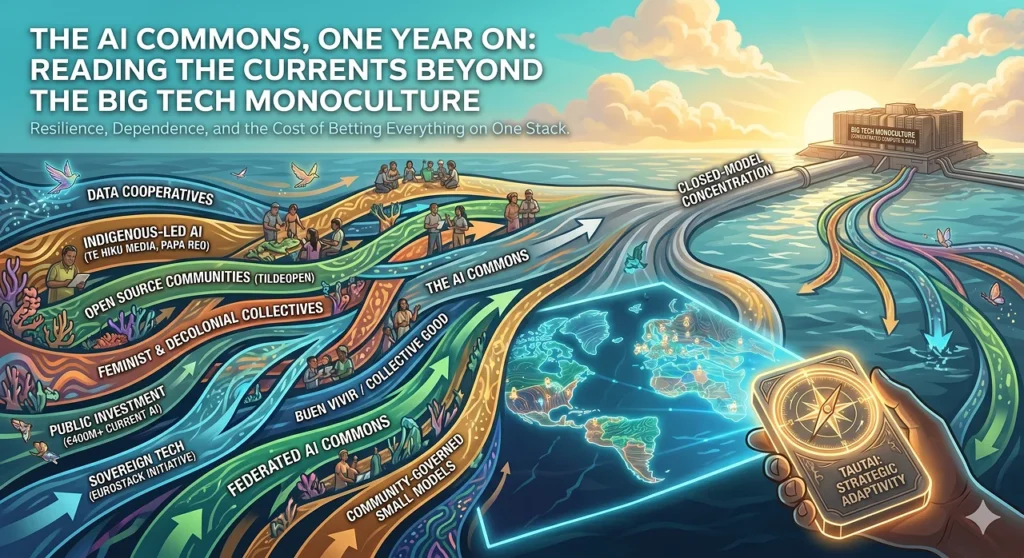
What a 2025 field scan of 200+ alternative AI projects tells leaders about resilience, dependence, and the cost of betting everything on one stack.
A little over a year ago, Coding Rights and One Project published a quiet but unusually useful document: a field scan called AI Commons: nourishing alternatives to Big Tech monoculture. It mapped 234 organizations, cooperatives, networks, and projects across Africa, the Americas, and Europe that are building components of a different kind of AI — one guided less by extraction and shareholder return, and more by collective good, ecological justice, and what its authors call buen vivir.
I pulled that dataset back out of the archive this month, not for nostalgia, but to navigate. A map is only useful if you check it against the water you are actually sailing. So the question for this Salon is simple: one year on, are these alternatives a fringe, or are they becoming a current strong enough to steer by?
What the original map showed
The report’s core argument is structural, not moral. Today’s AI is a monoculture: a handful of firms, concentrated overwhelmingly in North America, control the compute, the data, the foundational models, and increasingly the terms on which everyone else operates. Monocultures are efficient. They are also fragile — a single failure, price change, or policy shift propagates everywhere at once.
Against that, the authors — Joana Varon, Sasha Costanza-Chock, and colleagues — documented a scattered but real ecosystem: data cooperatives, Indigenous-led groups, open-source communities, and feminist and decolonial collectives, each imagining and sometimes deploying AI on different terms. Their companion policy brief for the G20/T20, Fostering a Federated AI Commons Ecosystem, was concrete about what would help it grow: public procurement that favours data and platform cooperatives, federated development of small, task-specific models rather than ever-larger general ones, dignified and fairly paid data labour, and serious attention to ecological footprint.
The honest finding was a gap. The vision was rich; the resources, coordination, and infrastructure were thin. A year ago, the AI Commons was mostly potential.
What actually moved in the last twelve months
Here is where the re-scan gets interesting. Several of the report’s “if only” conditions stopped being hypothetical.
Public money arrived with intent. At the Paris AI Action Summit in February 2025, France and a coalition of funders launched Current AI, a public-interest foundation with a €400 million initial endowment and a stated €2.5 billion target, explicitly aimed at AI “public goods”: high-quality datasets, open tools, and accountability infrastructure. For the first time, the commons argument had a checkbook attached.
Europe started treating the stack as a sovereignty question. The EuroStack initiative, led by Francesca Bria and a broad coalition, reframed digital infrastructure as public power — proposing, among other things, a European Sovereign Tech Fund on the order of €300 billion. In parallel, the EU’s Apply AI strategy (October 2025) and its network of 19 AI Factories on EuroHPC supercomputers began producing concrete output: in September 2025 the Latvian SME Tilde released TildeOpen, a 30-billion-parameter open-source model trained on public supercomputing. By January 2026, “digital commons” had moved from activist vocabulary to a discussion topic inside the European Parliament.
Open weights went mainstream — with an asterisk. Mistral, the French open-weight company whose pitch is explicitly about avoiding closed-model concentration, reached a $14 billion valuation in September 2025. Even OpenAI released open-weight models (gpt-oss, Apache 2.0) in August 2025 — its first since GPT-2. This matters, but it is also where a navigator must read the current carefully: as Widder, Whittaker, and Myers West argued in Nature, “open” weights are not the same as a commons. Releasing a model file is not the same as sharing the data, the compute, or the governance. Openness is necessary; it is not sufficient.
Community-controlled AI kept proving it works. The clearest counter-example to “you need Big Tech scale” remains Te Hiku Media in Aotearoa New Zealand. Their Māori speech-recognition model — built from 310 hours of community-donated recordings, trained on locally owned hardware — reached ~92% accuracy, outperforming larger players, while keeping the data under Māori Data Sovereignty Protocols rather than selling it. Over the last year their Papa Reo platform has continued to expand. It is a small, federated, task-specific model governed by the community that produced it — in other words, almost exactly the pattern the policy brief described.
The shape of the year, then: the AI Commons is no longer only a critique. It is acquiring money, infrastructure, and proof points. It is still far smaller than the monoculture it answers to, and “sovereignty” can curdle into a nationalist tech race rather than a genuine commons. But the direction of travel is real.
Why this belongs in a conversation about adaptive organizations
It would be easy to file this under “digital policy” and move on. That would be a mistake, because underneath the politics is a question every organization now faces: how much of your capability are you renting from a monoculture, and what happens when the weather changes?
Strategic adaptivity is the ability to sense shifts and respond faster than your environment forces you to. The AI Commons story is, from that angle, a story about viability — the capacity to maintain identity, keep creating value, and keep adapting as conditions change. Three observations are worth putting on the table for the Salon.
First, monoculture is a concentration risk, not just an ethical one. When your products, your knowledge work, and your customer relationships all depend on two or three external models you neither control nor fully understand, a pricing change, a deprecated endpoint, or a policy shift is no longer someone else’s problem. Diversity in your AI supply chain is the same kind of insurance that diversity in any supply chain is. While competitors are optimizing for the cheapest single provider, the adaptive organization is quietly keeping a second route open.
Second, the commons is a weak signal worth scanning. Federated, small, task-specific models; data cooperatives; sovereign infrastructure — these are early currents. Most leaders will notice them only once they are mainstream and the advantage of early sensing is gone. The point of a field scan like Coding Rights’ is precisely to read the periphery before it becomes the centre. How is your organization sensing developments that are not yet in the trade press?
Third, “open” is not a strategy; governance is. The lesson from the open-weights wave is that access without control of data, infrastructure, and decision rights leaves you dependent in subtler ways. For an organization, the equivalent question is not “are we using open tools?” but “who governs the data and the models our value creation depends on?”
Questions to carry into the room
- How long would it take your organization to switch its core AI provider if the terms changed overnight — weeks, months, or never?
- Which parts of your AI dependence are genuinely strategic, and which are simply the default everyone reached for?
- If a small, community-governed model can beat a giant on a narrow task it cares about, where is your narrow, high-value task that no general model will ever prioritise?
- Is “sovereignty” in your context a path to resilience, or just a more expensive way to build the same monoculture?
The Tautai navigators did not predict the ocean; they read it, and adjusted. The AI Commons will not replace Big Tech this year, and may never fully do so. But a year of evidence suggests it is becoming a current real enough to factor into the course. The organizations that notice early — and keep more than one route open — will be the ones still adapting when the weather turns.
Sources & further reading
- AI Commons: nourishing alternatives to Big Tech monoculture — Coding Rights / One Project (full PDF)
- Fostering a Federated AI Commons Ecosystem — T20 policy briefing (Coding Rights)
- France, funders launch $400M public interest AI initiative (Current AI) — Philanthropy News Digest
- EuroStack — A European Alternative for Digital Sovereignty (Bertelsmann / reframe[Tech])
- Europe’s Open-Source AI Landscape & AI Factories — European Commission
- Public AI — Open Future (AI and the Commons)
- Why ‘Open’ AI Systems Are Actually Closed — Widder, Whittaker, Myers West (Nature, 2024)
- Māori Data Sovereignty Inspires New AI Voice Models (Te Hiku Media) — IEEE Spectrum