
How Organizations Understand
The loop that comes before deciding, and how to build it in.
An organization cannot know its environment in advance, so it has to produce understanding while acting. Understanding is made from limited attention, early cues and plausible stories, by people together with their artifacts, forums and structures. It is distributed, not a leader’s insight.
White paper: draft v0.1, 17 November 2026. Flyer: draft v0.4, 17 November 2026. Neither has been reviewed as a whole.
Who it is for
A good fit
- Consultants and organization designers who need a way to talk about understanding that is not a communication program
- Leadership teams whose planning cycle closes slower than their environment changes
- Units that hold a lot of data and no account of their situation they can act on
- Researchers and practitioner-scholars who want the theory — Weick, Endsley, Boyd, Klein, Hutchins, Nonaka, Beer — and its use in one argument
Not a fit
- Anyone who wants faster decisions bought as an outcome; speed is a consequence of the quality of the model a unit acts on
- Organizations looking for a score for organizational understanding, or a maturity level
- Buyers of a dashboard that tells them what their situation means
- Readers who want one settled theory. The argument names where its theories disagree instead of settling them early
The problem it addresses
Analysis, research and the planning cycle all assume a situation that exists, waits to be observed, and can be described before anyone acts on it. In a stable environment that is a good assumption and the planning cycle is the right instrument. The trouble begins when the environment changes faster than the cycle can close, and when the act of observing and acting changes what is being observed.
Four assumptions fail in that territory.
- That the situation exists to be perceived before action. Much of the time an organization acts in order to find out. The act is a probe, and what it produces is information that did not exist beforehand.
- That more data improves the picture. Data does not say what it means, and information consumes attention. A unit can raise its data volume and lower its capacity to notice.
- That one actor holds the picture. The unit that thinks is not a person. It is a system of people, artifacts, routines and roles, and the picture is held between them.
- That understanding can be replaced by speed. Speed is a consequence of the quality of the model a unit acts on. Set as a target, it invites fast decisions on poor models.
Five activities, one loop
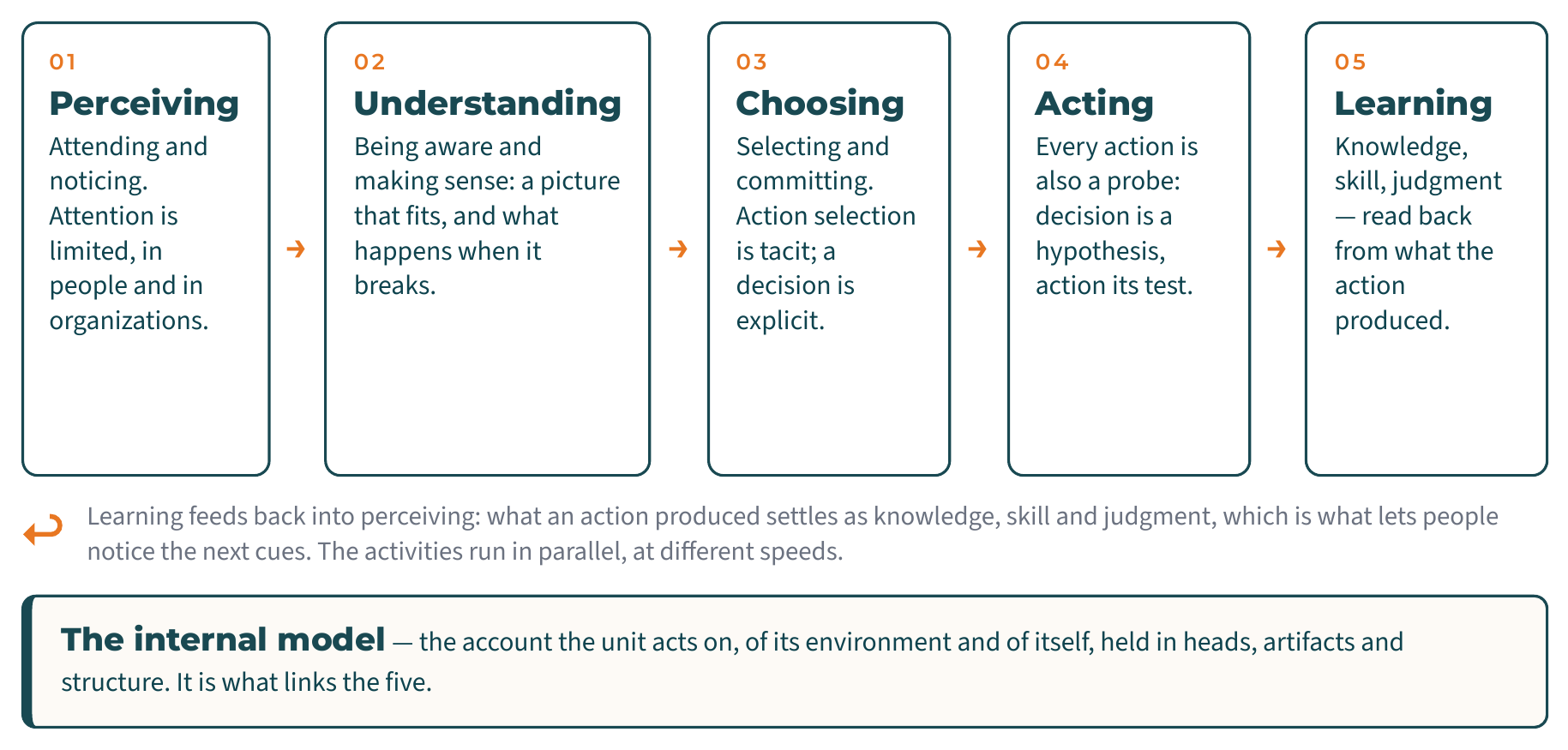
Understanding is not a stage between noticing and deciding. It is a loop of five activities, and every one of them has a collective form. The activities run in parallel, at different speeds, and feed back into each other.
Perceiving
Attending and noticing. Attention is limited in people and in organizations; what gets attended to is designed, usually by accident.
Understanding
Being aware and making sense. Situation awareness holds a picture that fits; sensemaking is what people do when the picture breaks.
Choosing
Selecting and committing. Action selection is continuous and mostly tacit; a decision is the explicit, accountable commitment others can rely on and later check.
Acting
Every action is also a probe. In the full loop, a decision is a hypothesis and the action is its test.
Learning
Knowledge, skill and, over time, judgment. What an action produced is read back, and what is learned settles as the capacity to notice the next cues.
The internal model is what links the five: the account an organization acts on, of its environment and of itself, held in heads, artifacts and structure. For experienced people, understanding and the action arrive together — “understanding comes first” describes a dependency, not a timeline.
An organization cannot know its environment in advance, so it has to produce understanding while acting.
Where understanding is held
Cognition is the propagation of representations across people, artifacts and media, which makes it traceable: one can see which step a person carries, which an artifact, and where the picture is lost.
Structure is cognitive architecture
Division of labor is division of cognition. Spans of control are spans of attention, and layers add latency, filtering and distortion. A handoff is a point at which a representation is re-coded for the next medium, and meaning is translated, lost or corrected on the way. In the language of the Viable System Model, the function that models the environment is System Four, and its test is severe: if nothing the unit decides depends on the model attributed to it, the model is trivial.
Groups can understand more or less than their members
Whether a group does depends on conditions rather than on goodwill: diverse perspectives, equal participation, social sensitivity and structured interaction. Two designs carry most of the weight: forums that separate the competition between accounts from the moment one is committed to, and psychological safety, which is a precondition for reporting rather than a mood.
Whose account counts is a question of power. Leaders give sense as much as they make it. The design question is not which interpretation the leader holds but whether orientation is enabled: identity and purpose set, forums kept open where accounts can compete, people who report weak signals protected, decision rights placed where the relevant model sits. When a frame collapses, role structure goes with it, and rebuilding it is leadership work.
What a diagnosis examines
Six grids, one per element of the design. Each is a set of questions asked of a unit, and the answers are written down as they are found before anything is changed.
Perceiving
What is attended to by design, which distinctions can the unit make, who may raise a cue and to whom, how is a cue amplified, is it safe to report, what do machines watch.
Models
Which accounts does the unit hold, where do they live, of what, who drew their distinctions, does anything decided depend on them, how and how often are they revised.
Choosing
Where do decision rights sit relative to the model, which commitments carry records, what releases an action and what stops it.
Representations and forums
What is the chain of representations and where are its handoffs, which forums separate frame competition from commitment, who gives sense.
Learning
Which of the four modes of knowledge creation run, and where; are the entry roles that grow judgment still there.
Rhythms
How often does each level re-orient, review and unlearn.
Two constraints govern the design. Recursion: every unit that faces an environment of its own needs its own understanding, so the grids are filled in per level, and one picture for the whole company hides what its parts need to see. Two places at once: knowledge is created by individuals and amplified by the organization, and it is also held by the system of people and artifacts, so every row asks both what the system holds and who among the people holds it.
Measuring understanding invites a trap that looks like rigor: the loop has countable properties, above all how fast it turns, and once they are counted they become targets. The alternative is to read the loop’s conditions as traces rather than rates — follow one cue from the edge to wherever it stopped; count how many commitments carry a record with an expectation, an owner and a review date; ask when the unit last changed its account of its situation and what made it do so. Speed and latency stay in the picture as outcomes to watch, never as targets to set.
What changes when models sit in the loop
AI makes content abundant and validated judgment scarce. The volume of candidates rises; the number of people who can tell a good one from a plausible one does not. The sharpest way to place a model in the loop is to ask which of the four modes of knowledge creation it can take over.
What a model can take over
Combination is what language models do best: recombining explicit knowledge at a volume no team can match. Externalization they can support, at the risk of replacing people’s own articulation of what they know.
What it cannot
Socialization and internalization it cannot perform for people, because both require a person doing something with others or with their own practice over time. An organization that lets machines take over combination and the entry-level tasks, and does not protect socialization and internalization, becomes better informed and less capable.
Delegation is legitimate only as deep as the capacity to evaluate what comes back — and the depth is set per task, not per organization.
What this does not promise
- Faster decisions
- A score for organizational understanding, or a maturity level
- A dashboard that tells you what your situation means
- The assurance that a redesign will improve adaptation
- That a leader’s clearer vision will do the work: the argument is explicitly against understanding concentrated at the top and delivered downward
What it does claim is narrower. If understanding is produced in a loop by a distributed system, then the shape of that system can be chosen, and choosing it is a design task rather than a communication task.
How you would know it is wrong
- If investing in shared understanding did not help. Organizations that invest in forums, representations and time for orientation adapting no better than organizations that invest only in faster decision paths or more data, in comparable complex settings.
- If delegation to models cost nothing. Organizations that delegate combination and interpretation without protecting socialization and practice keeping their judgment capacity as well as those that protect it.
- If the design could be installed without changing anything. The forums, records, channels and rhythms going in without any change in what the organization notices, chooses and learns.
The evidence position is stated plainly in the book and should not be softened: it is a synthesis with 122 evidence records behind it, and most of its central claims are assessed insufficient-evidence rather than supported.
How to start
Start with a trace, not a redesign. Four questions can be asked of any unit this week, and the answers are found by walking the chain rather than by surveying.
What does this unit attend to by design?
Take its agendas, dashboards and standing forums, and ask which of them were chosen and which happened. A cue that fits no distinction is not weak; it is invisible.
Which account does it act on?
Take the last three commitments the unit made, and ask what account of its situation each rested on. If nothing decided depends on the account that exists, the unit has a plan and a calendar rather than a model.
Who may raise a cue, to whom?
Follow one signal from the person at the edge who saw it to whoever could act on it. Count the handoffs, and name the place where it was dropped.
When did the unit last change its account?
If the answer is “at the annual planning round”, the model is being revised by the calendar rather than by what the unit’s actions produced.
What follows is not a program. The book’s own starting shape is three months for one unit at one level: a month tracing the loop as it is found and having the unit’s own people correct the description; a month installing the two cheapest elements — a commitment forum with decision records, and a channel for cues with a named receiver who tells the sender what happened; and a month in which the first review dates fall due. Then the next level of recursion. What travels from the first unit to the second is people who have run the loop once, not a manual.
Where this stands
The white paper is draft v0.1 of 17 November 2026. It restates the book, and the book’s job is the argument: How Organizations Understand is an open draft, published at tautai.net and not reviewed as a whole. The five activities and the loop are the book’s argument, with no thesis accepted by the field; the six grids are the book’s design, and no unit is shown running them; of 37 claim records, many are assessed insufficient-evidence, and the book says so itself.
Flyer: A5, two sides (PDF). The adjacent areas: Judgment Zones · Agency at Work · The Tautai Operating Model.
Your organization has data. Does it have a picture?
Take one cue and follow it from the person at the edge who saw it to whoever could act on it. Count the handoffs. The place where it was dropped is where the loop is broken.
The loop one level down, at the unit: Agency at Work. Its application to AI: Judgment Zones.