
Agency at Work
What agency is made of, and what a team can do about it.
Agency at Work is the team layer of the agency argument. It reads the same five dimensions at the person, the unit and the organization, and it starts where a capability program usually stops: with the question of which dimension binds this unit — and whether the binding constraint is even inside the unit.
White paper: draft v0.1, 17 November 2026. Flyer: draft v0.5, 17 November 2026.
Who it is for
A good fit
- Team leads and unit managers who are being offered another course catalogue
- Organizational development and HR who need to know which dimension binds before they buy anything
- Leadership teams that want to know why a capability program completed and the work did not move
- Consultants who need a defensible way to say that a block found in a team has its cause one level up
Not a fit
- Teams that want a score, a benchmark against other teams or a maturity level
- Buyers of a training program who want a certificate at the end
- Anyone who wants individual performance data out of it: no item asks about individual performance, and results are reported in aggregate
- Units looking for the assurance that agents will make them more productive
The problem it addresses
Talk to a leadership team about capability and you will hear one of three answers. Each answers one dimension of a five-dimension problem, and each is offered as if it answered all five.
More access
Licences, laptops, the new platform, an intranet full of courses. Access is the cheapest part of agency to buy and the easiest to count. On its own it is exposure: people are handed tools whose results they may not be able to check, in a unit that has not said who may override them.
More training
Courses, certifications, a reskilling catalogue. Training builds capacity, and capacity is one door of three. A skilled person in a unit that will not let them decide is not more agentic for the course; they are better equipped to notice that they cannot act.
More will
Ownership, mindset, empowerment, an away day with a speaker. Where capacity and room exist, this can be the missing piece. Where they do not, it produces motion: plans made with adrenaline, decided without a read of the room, and quietly reversed.
The AI twist makes the mistake expensive. Automating the junior work is the most defensible efficiency argument a team has, and it removes the occasions on which the next expert was made. A unit can raise its output this quarter and lower its capacity to evaluate that output in three years. The field calls it the pipeline paradox, and it is accepted working canon rather than a hypothesis still being tested.
Most teams are offered the dimension they already hold.
Five dimensions, three that gate
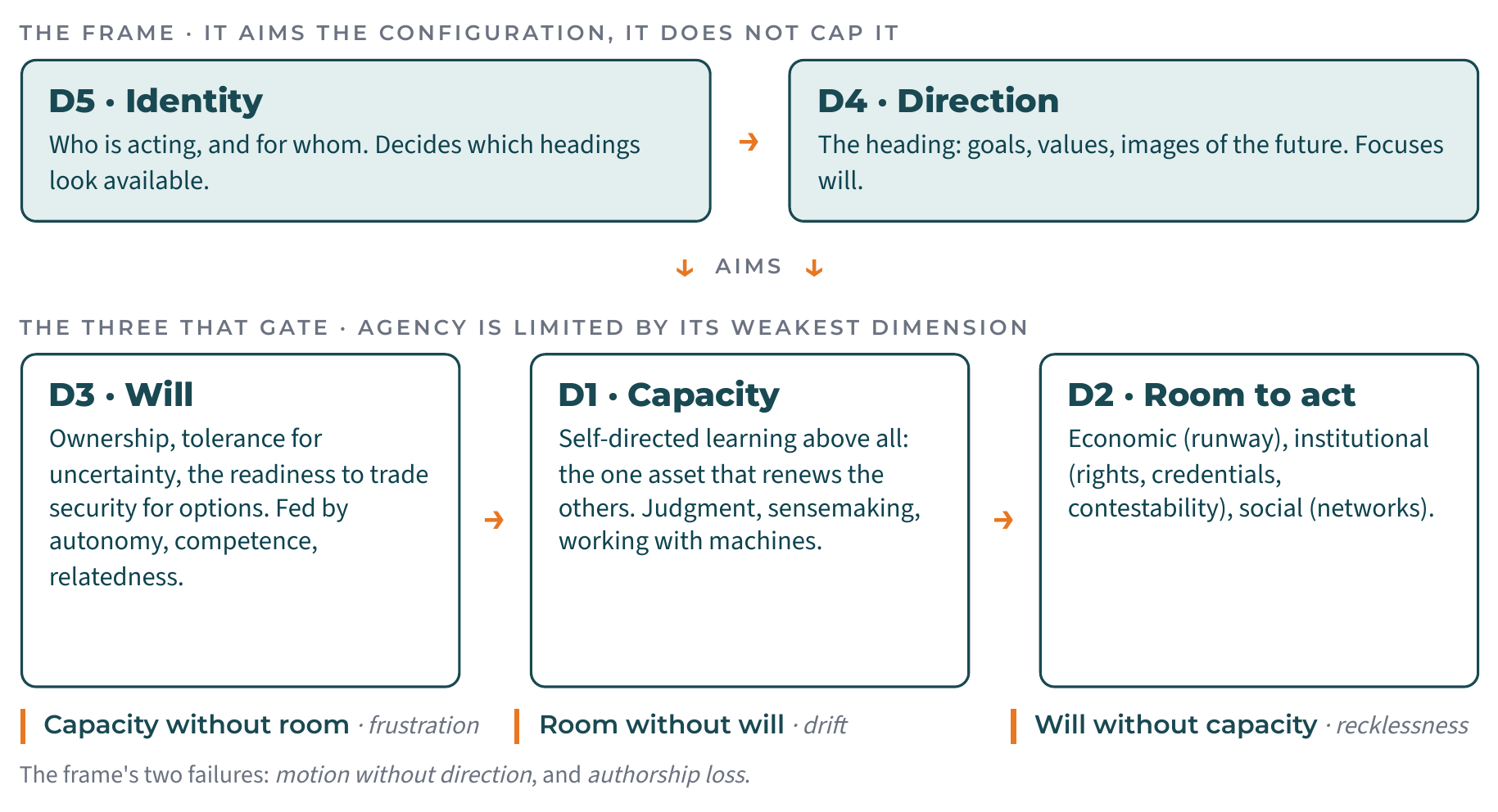
Three dimensions are operational and gate each other. Two frame the configuration and aim it. The rule is the sentence that makes the five a model: agency is limited by its weakest dimension.
Capacity
The ability to function and to keep functioning as conditions change. Its master capability is self-directed learning, the only asset in the set that renews the others. What a person already knows is inventory, and inventory expires.
D1
Room to act
The objective space of action, in three arenas: economic room, condensed into runway; institutional room — rights, credentials and, just as decisive, whether you can appeal a decision made about you; and social room, which is resource and constraint in the same breath.
D2
Will
The disposition to act: ownership of your own course, tolerance for uncertainty, and the readiness to trade the illusion of security for real options. It is fed by autonomy, competence and relatedness.
D3
Direction
The heading: goals, values and images of the future. A weak direction does not cap the configuration, it misaims it. Motion without direction is the most flattering of the failures, because from outside it looks like success.
D4
Identity
Who is acting and for whom. Its failure is authorship loss, where a role-story does the steering.
D5
Capability without room is frustration. Room without will is drift. Will without capability is recklessness.
The same model at three resolutions
At the person, the model is the manuscript’s claim. At the unit — a team, a crew, a department with its own customers — the five elements scale rather than repeat, and groups add one element a person does not have: honest signaling, whether bad news travels. At the organization, room becomes two-sided: the room it has outward, in markets and regulation, and the room it grants inward, as decision rights and delegation depth.
The person
The five dimensions, the gate and the two frame failures, drawn from a literature rather than from a study of teams.
The book: Agency Is All You Need
The unit
The field’s accepted working canon: nine concepts agreed as a working commitment on 2026-10-12. A unit that filters bad news navigates on a false map.
A consulting concept: five practice streams — team structure, people flow, continuous learning, roles in transition and AI fluency — in six phases, from qualification to exit. Talk to us about a team.
The organization
No company grade, and viability is indifferent to purpose: the level answers whether an organization can direct its course, not where it should point it.
under development
A dimension at one level is a condition at the level below. That is why the gate is always measured one level up.
What a reading may claim
Every element of a finding carries one of three marks: measured — a value on a stated scale, from a stated instrument, with n; read — a categorical judgment by a named reader from named evidence; asserted — a statement without instrument or evidence. An element moves up only when evidence or an instrument is attached, and it never slips down silently.
Conditions, or skill
Seven instruments read team conditions, each usable in a quick mode of a 60 to 90 minute workshop or survey, or combined into one profile. Two of them form a deliberate pair: the team agency audit reads the conditions, the AI fluency assessment reads the skill. Conditions without skill is a unit that will hand its judgment to a tool; skill without conditions is a unit that could check the tool and is not allowed to.
No individual data
No item asks about individual performance, results are reported in aggregate, and no finding can be used in a performance conversation. The unit sees its own profile, and the profile is written as questions the unit can act on.
What the practice does not promise
- A score, or a benchmark against other teams
- A maturity level or a certificate
- A promise that a team becomes agile or high-performing
- The assurance that agents will make the team more productive
Two results are explicitly admissible: the binding dimension sits above this team, and the finding goes up; and this team should not adopt agents yet — with the reason, and with what would change that judgment. A practice that cannot produce those two results is a sales instrument.
How you would know it is wrong
- The weakest-dimension rule. If teams whose binding dimension was addressed did no better at re-measure than teams that invested in their strongest dimension, the gate would add nothing to a list.
- The unit layer. If a unit’s conditions — latitude, information access, mentorship, safety — predicted nothing about how well it corrected its own course, the team layer would be decoration.
- The direction of the gate. If units that lack room were rescued by more capacity, or units that lack capacity were rescued by more room, the cross-level rule would be wrong about where to look.
- The pipeline paradox. If units that automated their junior work showed no change in the supply of people who can evaluate what comes back, the argument that links delegation depth to evaluation capacity would fail.
None of these tests has been run. The field has stated no falsification targets at this level; what is listed is the set of tests the model implies.
How to start
A team can read most of its own conditions without permission. Four questions do most of the work, and all four are answerable in a room.
May we override?
Name the last three decisions the team made about its own work, and who could have reversed them. If the answer is nobody in the room, the block is room.
Could we tell if the output were wrong?
Take the last piece of model output the team used. Ask who checked it, against what, and what they would have done if it had been wrong. If nobody can answer, the block is capacity, whatever the training record says.
Where do the next experts come from?
Name the work that used to make them and where it went. If a tool absorbed it and nothing replaced it, the block is the pipeline, and it is already running.
Does bad news travel?
Ask what happened to the last person who reported something unwelcome. A unit that filters bad news is navigating on a false map.
What a team cannot do itself is grant itself room. That is a decision for whoever holds the right.
Where this stands
The white paper is a draft, last changed in November 2026. The five dimensions at the person are the manuscript’s claim, not accepted canon; the nine team-layer concepts are accepted working canon, which is a governance state and not proof of truth; the organization resolution is under development; and the instruments have no measured results recorded in this field. Nothing in the paper is a research finding.
Flyer: A5, two sides (PDF). The same arguments, one level up and one level down: How Organizations Understand · Agency Is All You Need.
Which dimension binds this unit?
It is answerable before anything is bought, and the answer changes what should be bought. A block found in a team whose cause sits one level up is an organizational-design finding, not a training need.
The individual layer of the same argument: Agency Is All You Need.