
The Tautai Operating Model
How an organization stays viable by adapting continuously — and what has to be built inside it before that is a normal capability rather than a crisis.
The Tautai Operating Model is the model behind the books and the method work. It starts from a condition and a belief: uncertainty is the normal condition of organizations, and an organization’s only stability comes from constant adaptation. Everything else — agency, identity, authority, practice — is what that belief costs.
Two-sided A5 sheet, v0.1, and the big picture as an A0 poster, both of 17 November 2026. There is no white paper for this area yet: the flyer, the poster and the book carry the argument. The book is The Tautai Principle.
Who it is for
A good fit
- Leadership teams whose environment changes faster than their plans can be revised
- Units that face an environment of their own and could run the loop themselves
- Consultants and trainers who need a way to talk about adaptation that is not another transformation program
- Organizations that want the capacity built inside and left there, rather than a dependency on advisers
Not a fit
- Organizations looking for a destination: a target operating model in the classical sense, fixed and signed off
- Programs that treat uncertainty as a fault to be planned away
- Buyers of a maturity ladder or a certificate
- Anyone who wants the method to tell them what to value — it cannot
The problem it addresses
Uncertainty is the normal condition of organizations, not a fault to be engineered away. The environment changes faster than it can be known, and acting in it changes the terrain, so knowledge of what works is produced in action rather than before it.
Planning assumes the destination is known and the terrain holds still while the plan runs. Its answer is finished before the first move. Where the world cannot be made predictable, navigating has to do the work that planning cannot.
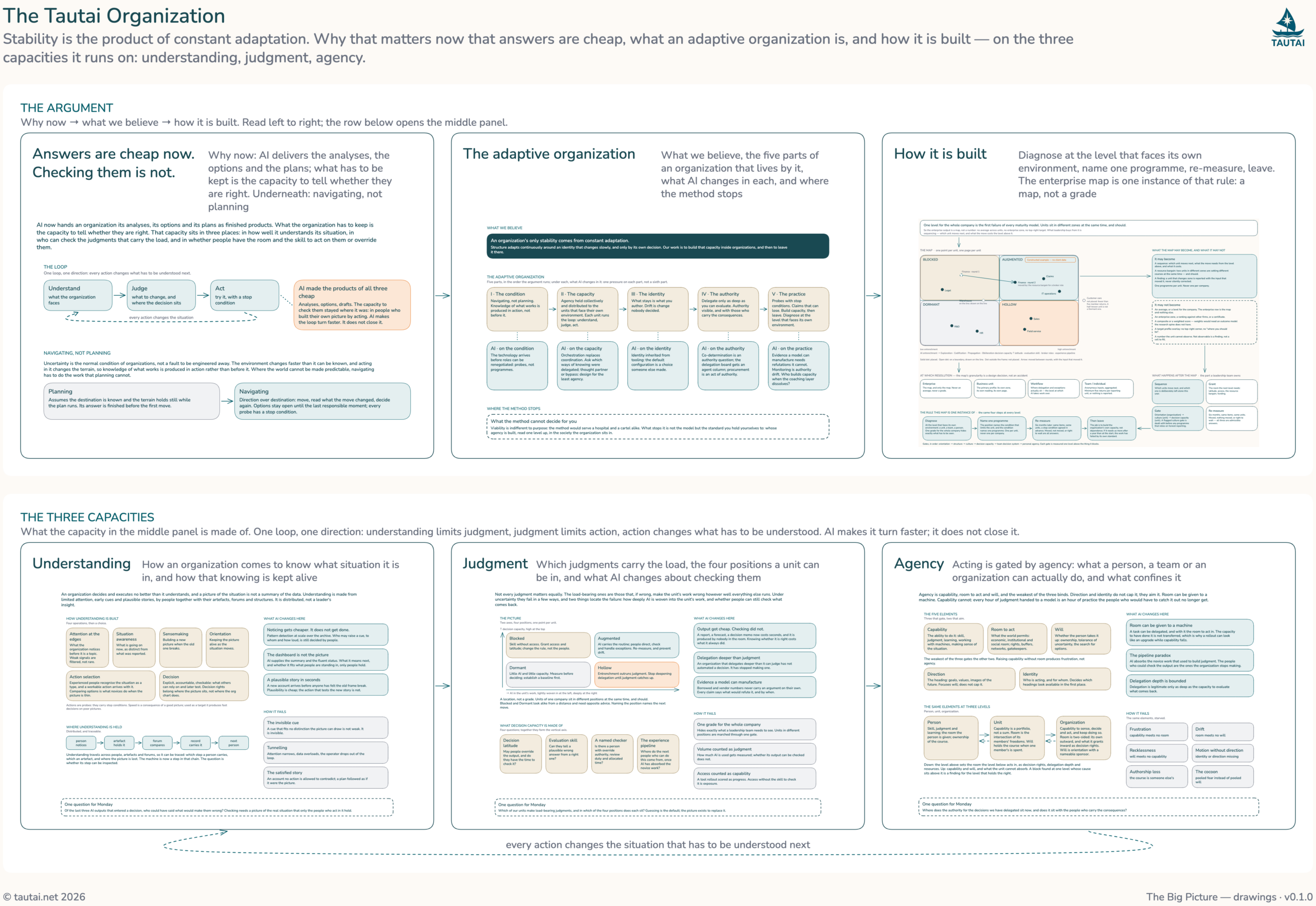
AI now hands an organization its analyses, its options and its plans as finished products. What the organization has to keep is the capacity to tell whether they are right. That capacity sits in three places: in how well it understands its situation, in who can check the judgments that carry the load, and in whether people have the room and the skill to act on them or override them.
The three-year roadmap, the vendor case study and the belief that more access means more capability fail in the same way: each assumes that the answer can be had before the acting starts.
The loop: understand, judge, act
Every unit that faces its own environment runs the same loop, at its own speed.
Understand
What the organization faces.
Judge
What to change, and where the decision sits.
Act
Try it, with a stop condition.
One loop, one direction: every action changes what has to be understood next. AI makes the loop turn faster. It does not close it.
Answers are cheap now. Checking them is not.
Five parts of the adaptive organization
Five parts, in the order the argument runs. AI is not a sixth part. It is one pressure on each of the five.
I · The condition
Navigating, not planning. Knowledge of what works is produced in action, not before it.
II · The capacity
Agency held collectively and distributed to the units that face their own environment. Each unit runs the loop: understand, judge, act.
III · The identity
What stays is what you author. Drift is change nobody decided.
IV · The authority
Delegate only as deep as you can evaluate. Authority visible, and with those who carry the consequences.
V · The practice
Probes with stop conditions. Claims that can lose. Build capacity, then leave. Diagnose at the level that faces its own environment.
Where the method stops
Viability is indifferent to purpose: the method would serve a hospital and a cartel alike. What stops it is not the model but the standard you hold yourselves to: whose agency is built, read one level up, in the society the organization sits in.
It would serve a hospital and a cartel alike.
What makes it different
- Navigating instead of planning. The answer is not finished before the first move: direction is set by moving, reading what the move changed, and deciding again.
- The capacity sits in the units. Each unit that faces its own environment runs its own loop; one loop at the top cannot see what its parts need to see.
- Identity is authored, not inherited. Drift is change nobody decided, and tooling hands an organization a default configuration that is a choice someone else made.
- Authority is bounded by evaluation. You delegate only as deep as you can check, and the record of who may decide sits with those who carry the consequences.
- The claims can lose. Every structural claim is stated with the observation that would count against it.
- Build capacity, then leave. The practice is designed to end, not to renew itself.
Where to read next
The Tautai Principle
The published edition
The belief core and the argument it rests on, in one book.
Judgment Zones
The second of the six steps, applied to AI
Where each unit of an organization stands with AI, and what it can do from there.
Agency at Work
The team layer
What agency is made of, and which dimension binds a team.
How Organizations Understand
The loop that comes before deciding
How understanding is produced, where it is held, and how to build the loop in.
The book, the model and the deep dives behind the picture: The Tautai Principle · Judgment Zones · Agency at Work · How Organizations Understand.
Where this stands
The model is stated in the belief core and drawn on the big picture. Its successor manuscript, The Tautai Organization, is a draft: eighteen chapters in five parts, structure accepted in November 2026, chapters still being written. The flyer shows the big picture, and the big picture has not been reviewed as a whole.
The flyer is A5, two sides, and is a draft of 17 November 2026. It is offered here because this area has no white paper yet; when it has one, it takes this place.
An organization’s only stability comes from constant adaptation
Structure adapts continuously around an identity that changes slowly, and only by its own decision. Our work is to build that capacity inside organizations, and then to leave it there.
The belief behind the model, the four areas it is applied in, and where each claim comes from: The Tautai Program.