
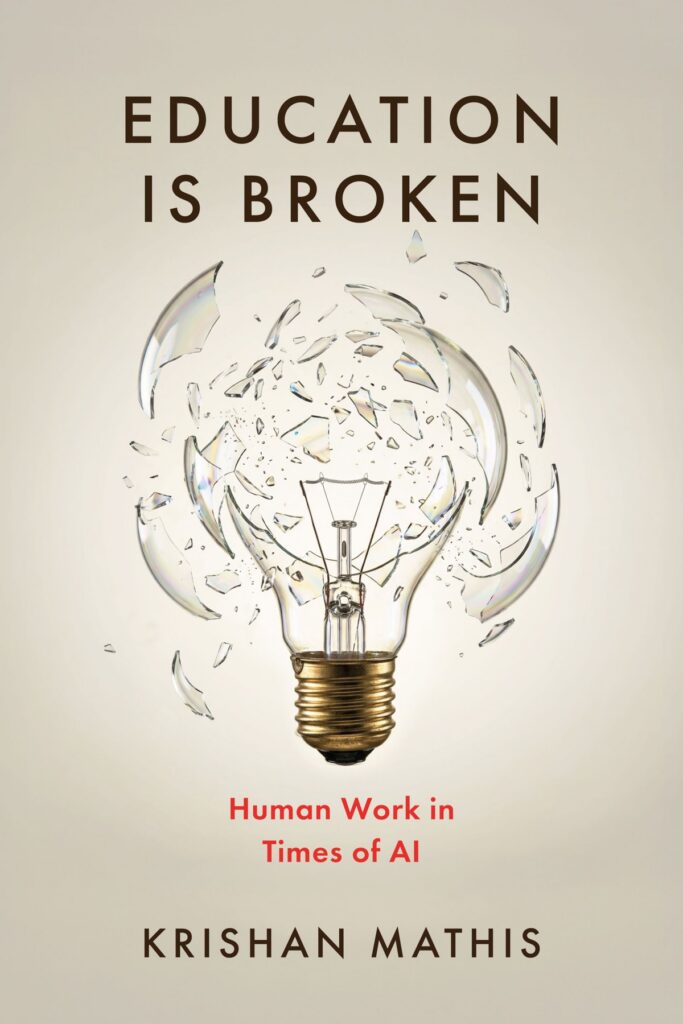
An overview of Education is Broken: Human Work in Times of AI by Krishan Mathis.
Why I wrote this book
This book began with a narrow question: what happens to human labor when artificial intelligence absorbs the routine cognitive tasks that have been the backbone of white-collar careers for decades? If AI replaces the entry-level analytical work through which junior professionals used to develop into experienced ones, then the pipeline that produces competent seniors — the people who can exercise judgment, oversee AI systems, and serve as sparring partners for complex decisions — is in danger of drying up.
That question seemed to require a straightforward answer: we need better training for the labor market.
That was the starting hypothesis. It did not survive contact with the material.
As I investigated what better training would look like, the question shifted beneath me. It moved from Ausbildung — training, the preparation for a specific job — to Bildung — education in the broader sense, the development of a person’s capacity to think, judge, adapt, and take responsibility in a world that does not hold still. The subject matter had its own logic, and it pulled the inquiry in a direction I had not anticipated.
Once the question became “what is good education?” rather than merely “what is effective training?”, the scope expanded. The investigation had to address not just skills and employability, but agency — the capacity to direct one’s own learning and life. It had to examine how credentials actually function as social signals, and who benefits when those signals change. It had to confront stratification — the persistent, structural ways in which educational systems reproduce inequality. And it had to take seriously the possibility that education’s purpose extends far beyond economic output, to democratic participation, social cohesion, and the ability to navigate a life under conditions no one can fully predict.
Who it’s for
This book is written for people who sense something is fundamentally wrong with how we prepare humans for work and life in an AI-driven world.
It is for leaders in organizations who are beginning to see that hiring problems are actually learning problems — that the skills gap cannot be solved by recruitment alone, but requires rethinking how capability is built. It is for HR professionals and learning officers who feel the inadequacy of traditional training approaches and are searching for something that actually works. It is for educators and university leaders navigating institutional pressure: rising costs, declining public trust, and the dawning realization that a degree no longer guarantees what it once promised.
It is also for people working in the gaps: independent professionals facing credential obsolescence, workers in career transition, and anyone asking the honest question — “Is this education system actually serving me, or am I serving it?”
The book assumes you are neither naive about the present system nor cynical about change. You have seen what does and does not work. If you are looking for a clear-eyed assessment of what is broken and a practical exploration of what might replace it, this is written for you.
What makes it different
Most books about education and AI fall into one of two categories. One offers grand theories about the future of learning that remain abstract and ungrounded. The other catalogs emerging technologies — AI tutors, blockchain credentials, competency-based platforms — without examining whether they actually address the underlying problems.
This book does neither.
Instead, it starts with a diagnosis grounded in evidence: rising costs, credential inflation, persistent skills gaps, and widening equity divides. These are not new problems, but AI changes their urgency and their stakes. The book then examines the deeper structural issues beneath these symptoms — issues of agency, institutional design, and social stratification that no amount of technology alone can solve.
Rather than betting on a single future, it explores three plausible scenarios — choice, fragmentation, and stratification — so you can see which choices lead where. It grounds the discussion in existing models and organizations that are already working: competency-based programs that have tracked outcomes, AI-assisted learning that is being deployed at scale, employer-led learning networks that are producing real results. It does not present these as silver bullets, but as evidence of what is possible when the design assumptions change.
The book also takes seriously what most education discourse ignores: the perspectives of learners themselves. It examines how agency — the experience of directing your own learning rather than being directed — shapes not just motivation but capability. And it confronts the question of who bears the cost when the system changes, and what justice looks like in an educational transformation.
What’s inside
The book moves through twelve interconnected chapters, each building on the previous one.
Part 1: The Diagnosis begins with a manifesto for education in the age of AI, then asks the fundamental question: what exactly is broken? This part maps the landscape of contemporary educational dysfunction, from rising costs to persistent inequality, and identifies agency — the capacity to direct one’s own learning — as the missed cornerstone of all educational design.
Part 2: The System explores how the current system became what it is. It examines the rise of the “intelligence factory” — the industrial model of education that optimizes for scale and standardization at the cost of meaning. It then looks at why systems change slowly, and why the most common reform efforts often make things worse by adding complexity rather than removing it. This part also surveys what is already working: new models of learning that point toward alternatives — from competency-based education to AI-assisted tutoring to peer-driven learning networks.
Part 3: The Mechanics dives deeper into the systems that hold everything in place. It examines credentials and how they function as social signals in a changing labor market. It analyzes the stratification trap — the structural ways educational systems reproduce and often amplify inequality even as they promise to reduce it. It investigates learning in companies, asking whether corporate training is a second chance for those left behind or a parallel system that deepens divides. And it examines how hiring practices and job requirements actually shape education, often in ways that serve neither learners nor employers.
Part 4: The Reframe steps back to examine the larger context. It asks what the role of universities should be in an AI era, and what public education owes society beyond economic competitiveness. It acknowledges that there is no single future waiting for us, and presents three different paths — and the choices that lead to each. It ends with practical guidance for individuals and organizations navigating this transition.
Throughout, the book includes diagnostic tools: frameworks for assessing where your organization or educational institution actually stands, questions to help you identify which assumptions are serving you and which have become invisible constraints, and pathways for beginning to experiment with alternatives without requiring a complete institutional overhaul.
What I think matters most
If you take only a few things from this book, take these.
First, recognize that education’s purpose has become ambiguous, and that ambiguity is itself the problem. We ask education to produce workers, but also to develop citizens. To provide economic opportunity, but also to preserve social cohesion. To prepare for the future, but also to transmit the past. These are not necessarily incompatible, but they are often in tension, and most educational institutions are trying to serve all of them at once without being clear about the tradeoffs. Begin by asking explicitly: what is education for, in your context?
Second, understand that credentials alone cannot solve credential problems. If the underlying issue is that signals have inflated, that employers cannot discern who actually possesses what capabilities, or that access to good education remains unequal, then simply adding more credentials or changing their form will not fix it. The signal system itself needs to change. That requires coordinated action between educators, employers, and the institutions that hold information about people’s capabilities.
Third, notice who gets left behind in every transition. Educational change always advantages some people and disadvantages others. The fastest way to see whether a proposed reform is genuine or merely performative is to ask: who bears the transition cost, and who benefits when the system stabilizes? If the answer is that the already-privileged benefit and everyone else bears costs, you are looking at stratification disguised as innovation.
Finally, remember that agency matters more than you think. In all the discussion of systems, technology, and institutions, it is easy to lose sight of a simple truth: people learn better when they have a genuine sense of directing their own learning. The most important shift in education is not a shift in credentials, technologies, or institutions, but a shift in the relationship between learner and system — from passive recipient to active agent. Everything else follows from that.
Additional resources: Companion site with tools, case studies, and ongoing research: companion.tautai.net